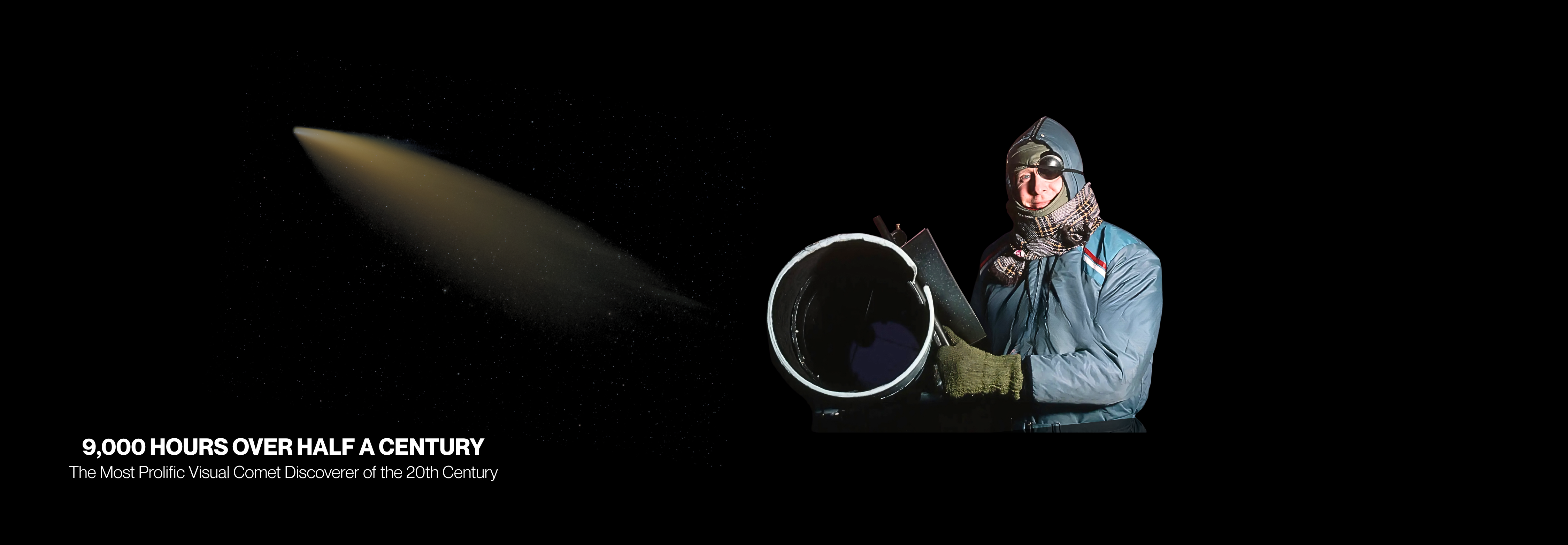
Donald Machholz, was born October 7, 1952, in Portsmouth, Virginia, and died August 9, 2022, at his home in Wikieup, Arizona.
Machholz developed an interest in astronomy at the age of eight. By thirteen, he owned his first telescope—a modest 2-inch refractor—and soon afterward located all of the Messier objects using a 6-inch Criterion Dynascope given to him by his parents. What began as childhood curiosity became a lifelong commitment to the night sky.
In 1971, Machholz entered the United States Army, serving as a meteorological observer. By day he worked with weather systems; by night he continued observing astronomical objects. While stationed in Yuma, Arizona, during the early 1970s, he began astrophotography, producing images that were later published in several astronomy magazines.
By the mid-1970s, Machholz developed a systematic sky-mapping method to aid visual comet hunting. After more than 1,700 hours of disciplined searching, he visually discovered his first comet on September 12, 1978. It marked the beginning of a singular career in observational astronomy.
Machholz was also one of the originators of the Messier Marathon, a single-night effort to observe all 110 Messier objects. Over four decades, he completed fifty marathons, contributing significantly to the practice and popularization of the event. Notably, Don completed the Messier Marathon entirely from memory, relying on internalized sky maps rather than written charts or guides. He wrote about memorization as both a practical observing method and a mental discipline, reflecting his belief that repetition, preparation, and long familiarity with the sky were as important as equipment.
Machholz is widely regarded as one of the most prolific visual comet discoverers in history. He is credited with the discovery of twelve comets, including the periodic comets 96P/Machholz and 141P/Machholz, as well as the non-periodic comet C/2004 Q2 (Machholz)—a bright binocular object visible to observers worldwide in 2004–2005—along with C/2010 F4 (Machholz) and C/2018 V1 (Machholz–Fujikawa–Iwamoto).
The significance of Comet 96P/Machholz lies not only in its discovery, but in its unusual nature. Unlike most comets originating within the solar system, 96P exhibits extreme orbital characteristics and chemical properties that set it apart from known comet families. For decades, its origin has been the subject of scientific debate, including ongoing discussion about whether it may have formed outside the solar system. The comet continues to be studied and written about today.
Don Machholz discovered 96P visually using a pair of homemade binoculars constructed from surplus military aerial lenses he purchased. At the time of discovery, the song “Against All Odds” by Phil Collins was playing on the radio—a small, human detail marking a moment that would become a lasting part of cometary history.
“96P is one of the most compositionally and behaviorally unusual comets in the solar system,” said Karl Battams, director of the U.S. Naval Research Laboratory’s Sungrazer Project, in early 2023.
“We are trying to science the heck out of it.”
Machholz’s twelve visually discovered comets place him among a very small number of observers worldwide whose work spans centuries of systematic visual comet hunting. His contributions reflect a continuity of practice that reaches back to Charles Messier and forward to future generations of observers.
An author and educator, Machholz wrote several influential astronomy publications, including A Decade of Comets (1985), An Observer’s Guide to Comet Hale-Bopp (1996), and The Observing Guide to the Messier Marathon (2002). From 1978 to 2000, he authored the monthly column “Comet Comments” for the Association of Lunar and Planetary Observers, serving as Comet Recorder for twelve years. In early 2022, he continued writing astronomy content for EarthSky until his death.
At the beginning of 2020, Machholz launched a weekly podcast, Looking Up With Don, dedicated to sharing the night sky with listeners. Each episode opened with, “What’s up in the sky this week?” and closed with, “God willing and pod willing, I’ll be back next week.” Don recorded and published his final episode just six hours before his death, at 3:09 a.m. on August 9, 2022.
Don Machholz believed that discovery did not require permission, credentials, or acclaim—only commitment. For more than fifty years and over 9,000 hours under the night sky, he lived that belief.
You don’t need permission to look up.
You need commitment.